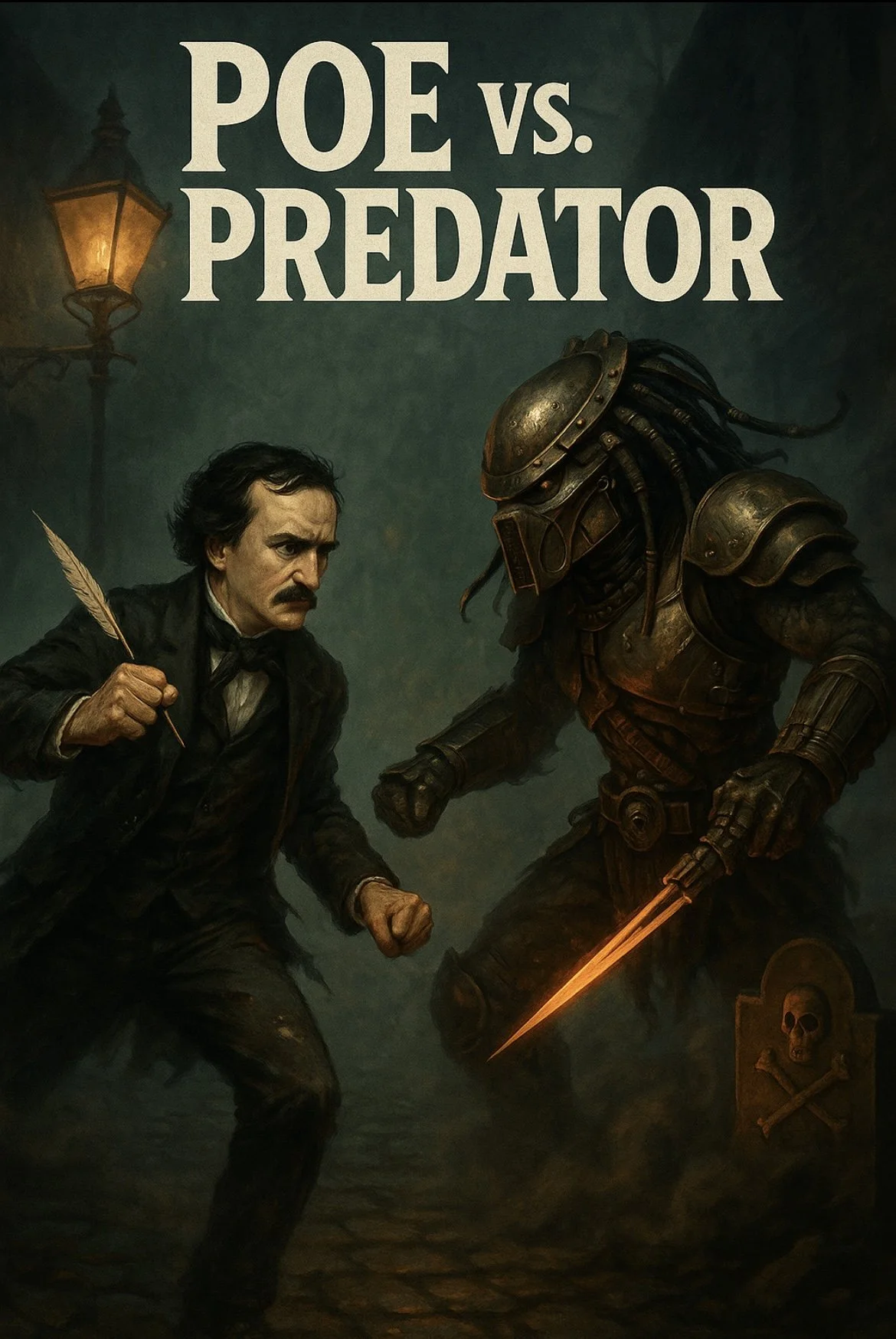
Poe vs. Predator
By Ryan Clark
PROLOGUE
Fact:
The “Poe Toaster” was the name given to a mysterious anonymous hooded figure who, for decades, visited Edgar Allan Poe’s gravesite in Baltimore on the writer’s birthday, Jan. 19, to leave a tribute of cognac and roses. The tradition continued for several decades, and the Toaster's identity … remains a mystery.
St. Mary’s Cemetery, Baltimore
Present Day — Jan. 19
Cool fog twisted through the crooked iron bars of the cemetery gate, rolling over moss-covered stones like a silent tide. The moon, pale and voyeuristic, peered down through a break in the clouds, casting long, skeletal shadows that reached across the graveyard like black fingers.
A lone figure moved through the fog—tall, cloaked, gliding with unnatural grace. Not a footstep broke the silence. Not a sound of breath escaped its hood.
It came to rest before a modest, weatherworn headstone.
EDGAR ALLAN POE
Born January 19, 1809 – Died October 7, 1849
For a moment, nothing moved. Then the cloak parted slightly, and a hand emerged. In it, three blood-red roses, freshly cut. The hand laid them carefully at the base of the headstone, followed by a glass bottle—half-filled with dark cognac, a seal of wax cracked at the top.
The figure stood still for a long while.
And above, the stars blinked in silence.
*
Baltimore, 1849
The alley reeked of rot. Horse manure, stagnant water, and the sour tang of unwashed bodies clung to the narrow passageway. Lanterns flickered along the brick walls, throwing long, sickly shadows that danced like specters. A man moved cautiously, hood pulled low, boots splashing in the puddles.
Tonight, he had a mark—a fellow in a carriage carrying coin. Easy pickings.
As he crouched to peer around a barrel, he froze. Something wasn’t right. The usual sounds of the alley—the scurrying rats, the clatter of metal, the muffled curses of the drunk—had vanished. Only the rain dripped, and the wind whispered through broken shutters.
A faint clicking sound reached his ears. Slow. Precise. Mechanical.
He reached for the knife in his belt.
A shimmer in the air, like heat wavering off the cobblestones, flickered briefly before him. The man blinked, heart hammering, and the world seemed to bend.
Before he could scream, a shadow slammed into him from above. The force knocked him to the ground, and metal blades extended with a terrifying snap. There was a high-pitched whir, a flash of red light, and then silence.
The alley stank even more now. The man’s body lay twisted, gutted with impossible precision, the walls spattered in black-and-red patterns that no human hand could make. His knife lay useless a foot away, still wet with his blood.
From the shadows, a pair of glowing red lenses scanned the alley. The creature crouched low, its breathing methodical and quiet, a hunter in its element. It stepped back into the dark.
Behind a stack of crates, the only witness to the evening’s events sat trembling.
It was a boy, eyes wide, fixed on the impossible — a predator that had just hunted a man as though he were nothing more than game.
The figure had just melted into the fog, leaving the alley smelling of death, fear, and wet stone. The rain continued its steady drum. Nothing else moved.
*
The boy stumbled out of the alley, clothes plastered to his skin, eyes darting. Every shadow seemed alive, every footstep behind him a threat.
He found a constable near the corner, a lantern swinging in the night.
“Sir! Sir! There’s… there’s a man… killed!” he panted. “In the alley by… by the docks!”
The constable frowned, gripping the boy’s arm. “Slow down, lad. Tell me what happened.”
“I—I saw him! Some… some thing! Big… red eyes… metal claws! It… it killed him! Right there!”
The constable’s brow furrowed. “Calm yourself. You saw a man get robbed or stabbed, that’s all. Nothing else.”
“No! It wasn’t human! It—”
The boy’s voice broke. He pointed toward the alley, now just a vacant set of cobblestones wet with blood.
The constable glanced cautiously at the alley, then back at the boy. “You’re either a liar or a fool, lad. Either way, we’ll send men.”
As they called for reinforcements, the boy backed away, glancing over his shoulder. Somewhere beyond the mist, the faint clicking resumed. Slow. Patient. Watching.
The city had no idea what was coming.
CHAPTER ONE
Baltimore, September 1849 – Two Weeks Before Poe’s Death
The Hanging Man
Rain fell in steady sheets, turning Baltimore’s cobblestone streets into steamy rivers of muck. Undergoing an unusual autumn heatwave, the city was restless—docks groaning, alleys whispering, lanterns flickering like dying eyes.
Inside The Hanging Man, a ramshackle tavern on the edge of the harbor, drunken laughter mingled with the plink of piano keys. Smoke clung to the ceiling beams. The scent of sweat, whiskey, and despair hung thick.
In a dark corner, slouched beneath the weight of his long black coat, sat the Poet.
He was thinner than people imagined—haunted more than mad. His dark eyes flickered in the candlelight, locked on a leather-bound notebook into which he scribbled with furious intensity. A glass of port—untouched—sat at his elbow, while a small flute completed this collection of his possessions.
Most knew him only by his last name, Poe.
Closest to him at a chair two tables away was Reynolds, an old sailor—weathered, broad, loyal to Poe beyond reason. They’d met after a poetry reading years ago, when Reynolds had dragged a heckler outside and thrown him into the gutter. Since then, he’d followed Poe like a brother, or perhaps a guardian angel in whiskey-soaked rags.
“Reynolds, for the first time in my life, I do not feel like drinking,” Poe said.
Reynolds’ eyebrows raised. “Yeah?”
“Yes. I feel like maybe, at this time, I am needed.”
“You mean you are needed — sober.”
“Aye — come with me.”
The pair made their way to the ladder that led down to the tavern’s wine cellar. In the basement, they were surrounded by bottles and barrels.
“This seems like a peculiar place for a man to remain sober,” Reynolds said.
“Tis not for me, sir,” Poe said. “This is a gift. Help me find the dry Spanish sherry.”
“What am I looking for?” Reynold asked.
“It’s amber colored. Best served chilled,” Poe replied. “Nutty aroma and a sharp, dry flavor.”
“Got it here sir!” Reynolds said, producing the bottle.
“Thank you, my good man,” Poe smiled through tired eyes, and the pair returned to the tavern’s main floor.
*
As they reached the top of the ladder, the front door to the tavern burst open.
A soaked newspaper boy stumbled inside, holding up a crumpled edition of the Baltimore Clipper.
“Extra! Extra! Man found skinned by the harbor—sixth victim this month!”
The tavern fell to a hush.
A wiry man at the bar muttered, “Six? Christ in Heaven. You don’t skin a man unless you’re sending a message.”
Poe looked up, still clutching his bottle.
The boy’s voice rang out again, almost gleeful. “Police say it’s the work of a madman. Or a gang. Body was—” he paused, unsure if he should continue.
“Go on,” someone said.
“Body was hung upside down. Skull clean removed. No blood.”
Gasps. Muttered curses. One woman crossed herself.
Poe made sure to grab his notebook on his way out. He passed Reynolds and patted him on the back.
“It’s time,” Poe said.
*
Outside, minutes later, Poe walked out into the night alone, notebook and bottle tucked inside his coat. The rain hissed on the stones, and as he passed a narrow alley, he paused.
Something had shifted. The air felt wrong. Yet somehow familiar.
He turned slowly. There—between two crates—a shimmer. Like heat rising from summer pavement, twisting the shadows.
And then… a clicking sound. Sharp. Alien. Calculating.
Poe took a step back. His boot splashed in a puddle, but he barely noticed.
Suddenly, a rat scurried past his foot, shrieking.
He spun around, and all at once the shimmer was gone.
Only the rain remained.
In his chest, an emotional pang. He made a note to drop in on his loved ones tomorrow to check on their well-being. Lenore especially.
*
The Next Morning – The Harbor
A crowd had gathered at the edge of the docks, surrounding a white tarp fluttering in the breeze. Flies already buzzed.
Poe stood apart, but close enough to see when the coroner lifted the sheet.
What was underneath was barely human anymore. Skin peeled like paper. Muscles carved with inhuman precision. No weapon could do this.
A uniformed detective cursed under his breath.
Detective Ambrose Fields, mid-40s, sharp but world-weary, noticed Poe watching.
“You again.”
Poe smiled faintly. “You need me.”
“I need a drink.”
“I’ve seen this before. Or… something close to it.”
Fields sighed. “Don’t start.”
“This is not the work of a man.”
“You know what your problem is, Poe?”
“Only one?” the Poet smiled.
“You see monsters everywhere. Sometimes it’s just a butcher with a knife.”
“Butchers don’t vaporize bone.”
Fields paused. His jaw twitched. “And what do you think it is?”
Poe turned to him fully, the wind tossing his cloak.
“I think it is a hunter. From a place far beyond even your narrow imagination. I think it sees us not as souls, but as trophies. And I think… this time, it has followed me to Baltimore.”
*
That Night – The Maddox Home
Lenore Maddox sat by the fire, mending her only good dress. Her father, Elias, a grizzled blacksmith with arms like tree trunks, sharpened an old sword at the table.
She’d heard the stories that were circulating around the city. She looked up. “Father, do you believe in demons?”
He stopped sharpening. “No. But I believe some men are worse than demons.”
Outside, a low growl echoed through the alley. Then a shimmer passed by the window.
Their candles snuffed out—one by one.
CHAPTER TWO
The Maddox Home – Fell’s Point, Baltimore – Midnight
The wind moaned through the broken chimney like a ghost refusing to pass on. The fire had long since died, and the coals in the hearth glowed dim red.
Lenore stood at the window, heart thudding. The fog outside had grown unnaturally thick. It clung to the glass as if trying to get in.
“Father?” she whispered.
Elias looked up from the whetstone, frowning. He followed her gaze. Nothing but the alley, slick with rain.
Then—
Click-click-click.
A sound like insect legs on bone. Subtle. Rhythmic. Not human.
Elias rose slowly, setting the sword down. He moved to the door and lifted the latch just slightly.
“Stay behind me.”
“No,” Lenore said. “Let’s just lock it—”
The door exploded inward.
Wood shattered like splinters from a cannon blast. Elias flew backward, crashing into the table, dishes and iron tools scattering across the floor.
A blur of movement. Something large. Almost invisible. The air shimmered where it stood, as though God had forgotten to finish drawing it.
Lenore screamed.
Then, an otherworldy monster stepped into view—not fully, not yet—but enough to see its height, its mass, the dreadlocked silhouette of its head, and the red glow of its optical lens.
Elias grabbed his sword with a grunt, slashing at empty air.
The blade passed harmlessly through mist.
The creature moved—too fast. It knocked him into the hearth, scattering coals. Elias roared in pain.
And then—
A lantern shattered against the wall. And a roar of fire erupted.
Poe stood in the doorway, hair wet with rain, cloak smoking at the edges. In his hands, a second lantern, already lit.
“Back, devil!” he growled.
The monster turned toward him.
Their eyes met—man and monster. For a fraction of a second, the creature paused. Scanned. Measured.
And Poe hurled the second lantern.
BOOM.
Flames engulfed the entryway. The monster shrieked a sound like metal scraping against rock—and it vanished into the smoke, its cloaking flickering like broken lightning.
After a moment, Elias staggered to his feet. “Is it gone?”
Poe moved quickly, examining the scorch marks on the floor.
“For now,” he said quietly. “But it’s wounded. It will return.”
Across the floor in a small puddle was a slick, glowing green substance. Poe bent down, and gathered some of it up in a few small vials, which he then pocketed.
He turned to Lenore. “Are you hurt?”
She shook her head, trembling. “What was that?”
Poe looked toward the broken door, and then pulled the vial out of his pocket. The green substance glowed.
“The future. A species of killer. We are not the first it has hunted. But if we’re clever… we can be the last.”
He stopped for a moment, then remembered the bottle of sherry in his pocket.
“A gift,” he said, giving the bottle to Elias and Lenore. “For the family.”
In the smoldering ashes of their kitchen, Elias and Lenore looked at each other.
“Thank you?” Lenore said quizzically.
Elias shrugged. “No better time to drink than the present. Open ‘er up!”
*
Later That Morning – Church of Saint Cyprian
Hidden beneath the church, in the candlelit crypts where the poor were buried in unmarked graves, Poe sat with Father Dorian, the blind priest whose memory was longer than the city’s written history.
Lenore and Elias waited nearby, both silent, both shaken.
“You know of this thing?” Poe asked the priest.
“I’ve heard the stories,” Father Dorian rasped. “Whispers from the old country. Carvings in bone. Men vanishing with their spines torn from their backs. Something… from the sky.”
“Why now?” Elias asked.
“The city is sick,” the priest said. “You feel it. The opium. The corruption. The hunger. Combined with the heat. This Predator comes when the soul of a place is burning and ripe for harvest.”
Poe was silent for a moment, then murmured: “So it feeds on rot.”
“Not feeds,” the priest said. “It celebrates it.”
*
In the Fog Above the Rooftops – Same Morning
The monster leapt from spire to spire, wounded but eager. From its belt, it removed a small vial containing a dark liquid.
It poured the vial onto a slab of metal on its wrist, and at once a paste was created. The creature took the paste and slathered on its injured ribs. It stung in an insufferable way.
It could not stop the howl that exploded from its mouth, and the bellowing sound seemed to echo for miles.
CHAPTER THREE
Flashback – United States Military Academy, West Point – Winter 1831
Snow fell in heavy silence over the Hudson River, blanketing the grounds of the academy in white. Cadet Edgar Allan Poe stood alone near the edge of the riverbank, coat collar high, his black boots crunching through the icy crust.
He was supposed to be in drill formation. Instead, he was chasing shadows.
Poe looked up toward the treeline beyond the parade grounds. For three nights, he’d woken to the same sound—click-click-click—from just beyond the dormitory walls. Always in threes. Always when the moon was high.
At first, he’d thought it a prank. Then, a warning. But last night, he’d seen it.
A shape, manlike but distorted, perched atop the barracks roof—glinting eyes, long limbs, almost invisible in the moonlight. When he’d reported it, the officers had laughed. They already thought Poe strange.
That morning, one cadet had been reported missing. No footprints. No blood. Just his uniform, folded neatly beside his bunk.
Now, Poe stood at the treeline where he’d tracked a series of clawed prints. He drew a small pistol from inside his coat—barely enough to scare a fox, but it steadied his hand.
“Whatever you are…” he muttered, “…you will not take me quietly.”
The only sound was the wind creaking and twisting through the trees.
Then— a shimmer. Right in front of him.
Something heavy dropped into the snow.
A dead animal—a deer, its ribcage skinned and open, yet bloodless. A single silver medal had been placed inside its chest cavity … a medal that belonged to the missing cadet. It was a message, and a challenge.
Poe raised the pistol—
Just then, a blast of heat seared past his shoulder, striking a tree. The bark exploded into splinters.
Poe dove into the snow. Rolled. A blur darted above him.
The shadowed beast landed behind him—partially cloaked, tendrils whipping from its helmet, its mandibles clicking in anticipation.
Poe crawled back, panting, until—
A CRACK of gunfire.
Major Bartholomew Crispin, a grizzled artillery instructor, emerged from the trees, musket still smoking. The beast hissed, turned—and then vanished in a flicker of light.
“Get up, Poe!” Crispin barked.
Poe staggered to his feet.
“You saw it too,” Poe said breathlessly.
“I’ve seen more than I care to admit,” Crispin said. “There are things in this world—things that are beyond wars and reason. You stay silent. You didn’t see this. It did not happen. You understand me?”
Poe didn’t answer.
“I said do you understand?”
But Poe was already pulling a charcoal pencil from his pocket, sketching furiously in a small notebook. The lines came fast—blurred eyes, clawed hands, rows of teeth, symbols on a gauntlet…
The shape of a new madness.
CHAPTER FOUR
Baltimore – 1849
Back in the crypt beneath St. Cyprian’s, Poe sat alone.
Lenore approached quietly. “You’re drawing again,” she said.
He looked up. His eyes were sunken, but clear.
“I saw it once before,” Poe whispered. “At West Point. It came after us in the snow, like maybe it was practicing for other times, warmer times, when it could return. They made me deny it, bury it, but I never forgot.”
He showed her the faded sketch, the one he’d drawn nearly 20 years before.
“It’s in my poems. My nightmares. The Raven. The Pit and the Pendulum. Berenice. They all came from this, this thing I wasn’t allowed to name.”
Lenore looked down at the paper. “Then maybe it’s time you name it.”
Poe turned the page over.
In a trembling hand, he wrote:
“Predator.”
*
The candles burned low, their light trembling against the damp stone. Outside, thunder prowled across the harbor. Seated, Poe continued to sketch.
“You’ve not slept,” Lenore said.
“How could I?” His voice was rough with exhaustion and something deeper. “Each moment I spend here, I think of you—of what this creature might take from me… from us.”
She laid a hand on his sleeve. “You are not alone in this.”
He turned, eyes dark and fever-bright. “You are the only light I have ever trusted,” he said. “Every word I have written… every desperate rhyme… was for you, though I never dared to say it.”
The storm outside cracked like a cannon. Lenore did not flinch. “Then say it now.”
Poe’s breath caught. He nodded. From his pocket, he produced a small heart-shaped locket. “I do not have much,” he said. “But I want you to have this.” Slowly, almost reverently, he traced a gloved finger along her cheek. “Lenore… you are my world. My muse. My final line.”
She leaned closer, until their foreheads touched and the scent of rain and candle smoke mingled between them. He stared longingly at her face, flawless; her dark brown eyes framed by loose black curls that drizzled down her front and back.
“Then write it,” she whispered.
Their lips met—soft at first, then lingering, a smoldering promise against the chill of the crypt.
When they parted, neither spoke. The silence said everything.
*
Flashback — West Point, New York — January 1831
Snow had a talent for preserving silence.
It muffled the ceaseless barking of the Hudson winds and softened the hard edges of the Academy until the stone buildings appeared less like instruments of war and more like monuments erected to forgotten dead. Cadets crossed the parade ground in dark lines, boots crunching against the frost, their laughter rising in pale clouds before dissolving into the gray morning.
Poe heard none of it.
He stood at the edge of the woods beyond the drill field, gloved fingers wrapped around the stock of an old musket borrowed from the armory under circumstances he preferred none examine too closely.
The tracks remained.
He knelt.
They descended the snowy embankment in a staggered line: three impressions, then nothing. Not boot prints. Not the split hoof of deer. Not wolf.
Too large.
Too deep.
Each mark possessed the vague suggestion of toes.
Five of them.
Poe touched one carefully.
The snow at its center had hardened into an odd sheen.
Melted, as though something hot had pressed briefly against the earth before vanishing again into the trees.
He swallowed.
"No," he whispered.
His breath trembled before him.
"Not again."
He had seen it before.
A shape half-glimpsed among the pines during maneuvers. A distortion in the air. The impossible clicking sound that had awakened him in the darkness outside camp.
He had convinced himself it had been exhaustion.
An overactive imagination. The unfortunate consequence of a mind forever inclined toward specters.
A crack echoed deeper within the forest.
Poe lifted his head.
Another.
Not wood settling.
Not branches breaking beneath snow.
Click.
Click-click-click.
The sound carried through the trees with terrible deliberation.
His pulse quickened.
Every sensible instinct urged retreat.
Instead, he stepped forward, and the forest accepted him.
Snow dragged at his boots as bare branches crowded overhead. The world narrowed to white and black and his steps matched the ragged rhythm of his own breathing.
Click.
Closer now.
He raised the musket.
"Who goes there?" he called.
Only silence answered.
Then—
Movement. A shimmer.
Twenty yards ahead, the woods bent.
No.
Not bent. Distorted.
The shape detached itself from the trees.
It towered above the undergrowth.
Broad shoulders.
Long limbs.
Its outline rippled like heat rising from summer stone despite the bitter cold.
Poe's heart seized.
The creature regarded him. He could feel it. Though invisible, its attention possessed weight.
Intelligence. Curiosity.
The clicking ceased.
Slowly, almost ceremoniously, the distortion tilted its head. Studying him.
Poe forgot the cold. Forgot West Point. Forgot the absurdity of what stood before him.
The thing before him was no beast.
It was a hunter.
He tightened his grip upon the musket.
"What are you?" he whispered.
A voice answered from the trees.
"Mr. Poe!"
The distortion vanished.
Major Crispin emerged through the snow accompanied by two officers.
"There you are," Crispin barked. "Absent from morning formation. Again."
Poe swung back toward the clearing.
Nothing remained. Only untouched snow.
"No," Poe said. "It was here."
Crispin frowned. "What was here?"
Poe pointed toward the trees. "You did not see it?"
"See what?"
"The creature."
The officers exchanged glances.
Poe heard the unspoken judgment pass between them.
He pressed on.
"It has been observing the Academy. There are tracks—"
"Enough." Crispin’s voice hardened. "You abandoned your assigned duties to wander the woods chasing ghost stories?"
"It is no ghost."
"You are a cadet, Mr. Poe, not the author of penny dreadfuls."
Poe looked back once more.
Nothing.
No tracks. No shimmer.
Only winter.
His certainty faltered. Had it truly stood there?
Or had imagination, his oldest companion, finally betrayed him?
Crispin removed the musket from Poe's grasp.
“You have neglected drills, ignored inspections, missed classes, and now you disappear into the woods with government property armed and raving about monsters.”
Poe opened his mouth. Closed it.
How could he ever explain such things?
The clicking. The melted snow. The impossible shape watching him from between the trees.
"You may explain yourself before the tribunal," Crispin said.
Poe lowered his gaze. "Very well."
As the officers escorted him back toward the Academy, he risked one final glance over his shoulder.
High among the dark pines, nearly hidden against the winter sky, two faint points of crimson light regarded him.
The creature stood motionless.
Invisible save for the briefest distortion of falling snow.
Watching.
Waiting.
Poe looked away first. And he would never again return to West Point as a cadet.
CHAPTER FIVE
The Forbidden Library, Beneath the Peabody Institute, Baltimore, 1849 — the following day
There were rooms beneath Baltimore no one spoke of—catacombs not meant for graves, but for knowledge too dangerous to shelve.
Poe had only read whispers of them in footnotes, in journals that bore ink like bloodstains. The rooms were built before the Institute itself, sealed behind stone doors and chained in rusted iron.
But Detective Fields had a key.
“I’m risking my badge, my soul, and my sanity,” the detective muttered, shoving open the heavy door. “Let’s find your demon.”
The library was vast and cold, lit only by the green-blue flicker of Poe’s lantern. Dust hung thick in the air, and the shelves groaned with forgotten weight.
The four of them entered cautiously—Poe, Lenore, Elias, and Fields. The air smelled of parchment and mildew, like time itself had grown damp.
“What exactly are we looking for?” Elias asked.
“Patterns,” Poe said. “Evidence of the same creature across cultures. This Predator has visited before. I’ve seen the aftermath in nightmares and stories. If it hunts civilizations, it leaves scars in their myths.”
They fanned out.
Lenore sifted through brittle scrolls from Egypt. She paused on one:
A god of the hunt, whose face was hidden by mirrors, descending from stars in fire to take the skulls of pharaohs “who dared speak to the sky.”
Elias found a stone carving—Sumerian—in which a horned being stood atop a ziggurat, holding a man’s spine aloft like a trophy.
Fields pointed to a worn book from the Crusades, bound in skin, in which a Templar knight described “a war between the angels of fire and the shadows without souls.”
Poe worked quickly, pulling volumes from every shelf. He stopped suddenly—hands shaking—as he uncovered a Latin manuscript older than the printing press.
Its title: “Venatores Caeli.” “Hunters of the Sky.”
Within were drawings—helmets, weapons that burned without fire, images of men flayed and suspended in trees.
“This is it,” Poe whispered. “This is the same beast. It’s been coming here for centuries. It selects our greatest warriors. And if we fail, we’re… harvested.”
He turned to the final page, where a crude drawing showed a circle of stars—constellations drawn not from Earth’s sky, but a hunter’s perspective.
Below it, a name:
“Yautja”
And beneath that, a phrase scrawled in ink long faded: “The Yautja may be wounded. But only by one who has also seen the void.”
Poe’s hand trembled.
Lenore stepped closer. “What does it mean?”
“It means,” Poe said slowly, “we must become hunters ourselves. If we are to stop this thing, we must learn to think like it. To see not men, but prey.”
Fields sighed and crossed himself. “Great. Now we’re the monsters.”
“No,” Poe said. “We are the reckoning.”
*
Later That Night – Outside the Library
The group emerged into the steamy night air. Thunder cracked across the harbor. Another storm was building.
Behind them, deep in the forbidden alleyways, something moved.
A silent shimmer. Watching. Waiting.
CHAPTER SIX
The Hanging Man – Midnight
Smoke-stained beams sagged above the crooked sign: A painted figure in a noose, faded to a gray grin. Inside, the lamps sputtered in oily glass and the oak floorboards sighed with every step. The Hanging Man was Poe’s escape, his shame, and sometimes his inspiration. It was where he drank away the echoes in his head, where he scribbled verses on napkins and dreamed of Lenore when no one was looking.
But tonight, Poe didn’t show.
Instead, the old sailor Reynolds sat alone at the bar, waiting.
“Where’s Poe?” the barkeep asked.
Reynolds chuckled. “Off chasing shadows, no doubt. Told me he had ghosts to fight. Said if I didn’t see him by dawn, I should find the girl and tell her…”
He stopped.
The mirror behind the bar flickered.
No one else noticed the shimmer.
The barkeep turned. “You alright, Reynolds?”
Reynolds stared past him.
His voice dropped.
“God save us,” he whispered.
Glass exploded.
A blur moved through the tavern—a gust of wind that howled like a storm. Barstools scattered. A man screamed. The barkeep was hurled against the wall, unconscious.
Reynolds stood, pulling up all of his six-plus decades of courage. “Face me, coward!”
His hand reached for the pistol at his belt—but he was too slow.
The Predator uncloaked fully.
Towering. Glowing. Clicking with glee.
Reynolds pulled and fired. Once. Twice. Useless.
The creature struck. A blur of claws. Blood sprayed across the bottles lining the wall.
And then silence.
*
Poe heard the destruction from streets away. He and Lenore, now accompanied by a crowd of onlookers, rushed to The Hanging Man.
But they were too late—the tavern was now an empty mess. Save for one thing.
Pinned to the wall with a bar spike was Reynolds’ hat—and above it, a human spine, stripped clean, still warm, still dripping.
Poe collapsed to his knees.
“He died for me,” he whispered.
Lenore knelt beside him. “I’m so sorry—”
Poe turned to her, eyes dark and distant.
“No more stories. No more poems. This ends now.”
He stood and reached into his coat. Pulled a vial filled with glowing green liquid—the Predator’s blood.
He held it like a relic.
“I will write its obituary in blood.”
*
Richmond, Virginia — Autumn 1831
The rain had a peculiar talent for finding its way indoors.
It crept beneath warped window frames and dripped steadily into dented pans placed upon the floorboards of the small Richmond house where former Cadet Poe had become, once again, an unwelcome guest.
The house belonged to cousins who tolerated him with that uniquely Southern combination of charity and exhaustion. Poe occupied their attic.
The room was scarcely larger than a coffin, with a narrow bed and a washstand. A small writing desk whose surface had been scarred by generations of ink and candle wax flanked one side.
He reached into his pocket and pulled out a small flute. Music was always a way to escape, especially when he had no drink or medicines. In a low, slow rhythm, he recalled a sad tune from his youth, and he became lost in it for a moment.
As it turns out, the dismissal from West Point had followed him southward like a disease.
Failure. Madness. Or simply living up to his underachieving nature.
The reason for his non-success could have been a combination of all three, depending upon whom one asked.
He stopped playing and placed the flute on the desk. Next to it was the latest letter from his foster father. He unfolded it and reread its contents by candlelight.
“We regret that you’re latest pursuits have left us exhausted …”
No assistance. No forgiveness. No money.
The words had become familiar enough that they scarcely wounded him anymore.
He tossed the letter aside.
Outside, Richmond drowned beneath the muggy October rain.
Poe had published poems before.
Few had cared.
He had sought military distinction.
He had failed.
He had pursued respectability.
It had slipped through his fingers.
And always—always—he remembered the incidents in the West Point woods.
Snow melting beneath impossible footprints. The clicking. The thing regarding him from among the pines. A fever dream. Surely.
He pressed the heels of his palms against his eyes.
He once again saw the shimmer and form in front of him.
No. Not a dream. A sharp crack interrupted his thoughts.
He looked toward the window.
The sound came again.
Tap.
Tap.
Tap.
He frowned.
A tree branch perhaps?
The attic window overlooked the narrow alley behind the neighboring houses.
No trees grew there.
Tap.
Tap.
Tap.
Poe rose slowly.
Rain streaked the glass. Gas lamps transformed the alley below into pools of amber and shadow.
Nothing moved. His reflection stared back at him.
Hollow cheeks. Dark eyes. Twenty-two years old and already feeling ancient.
He exhaled.
"You are becoming absurd," he muttered.
Then—
A voice drifted upward from the alley.
"You …. ."
He froze.
The voice was odd, mechanical and maniacal.
It beckoned.
His breath caught painfully in his throat.
No.
No.
"You ..."
He stumbled backward from the window.
Rain battered the roof. Once again, silence settled over the room. His pulse thundered in his ears.
Slowly—against every instinct—he stepped forward once more.
He wiped condensation from the pane.
The alley lay empty.
Then, the rain changed.
Drops struck something unseen.
For the briefest instant, the darkness bent. A towering outline materialized. Broad shoulders. A smooth mask. Long, hanging tendrils framing an inhuman face.
The figure stood motionless in the alley, looking directly up at him.
The candle slipped from Poe's fingers. It struck the floor and sputtered out.
Darkness consumed the attic.
He stumbled toward the desk, fumbling through scattered papers until his shaking hands found a box of matches. When at last he relit the flame and rushed back to the window—
The alley was empty. Only rain.
He pressed trembling fingers against the cold glass.
"No..."
His voice emerged as a whisper.
"It’s following me."
The realization settled upon him with dreadful certainty.
West Point. The Hudson. Now Richmond.
Hundreds of miles. But it had found him. Or perhaps—he thought with sudden horror—it had never stopped watching.
A sound escaped him. Not quite laughter. Not quite despair.
"What have I done," he whispered, "to merit such attention?"
He lowered himself into the desk chair. The candle flame trembled.
Outside, thunder rolled across the city.
His gaze drifted to the blank sheet of paper before him.
He stared at it for a long while.
He could tell no one. Who would believe him?
A dismissed cadet. An impoverished poet. A young man prone to melancholy and flights of imagination.
Monster stories. Invisible hunters. Mechanical voices. He imagined the expressions such confessions would inspire.
Pity. Ridicule. Concern.
No. If he spoke plainly, he would be dismissed as mad.
But perhaps... perhaps truth required disguise.
His pen hovered over the paper. The creature hunted in darkness. It wore masks. It borrowed voices. It transformed grief into weaponry. Its presence announced itself not through revelation, but through suggestion.
A shadow glimpsed at the edge of sight. The certainty that one was not alone.
He dipped the pen into ink. For the first time in months, words arrived not as labor but as necessity.
He began to write.
Deep into that darkness peering,
Long I stood there wondering, fearing...
He stopped.
No.
Not quite right.
He scratched through the lines.
Started again.
A tale of a man pursued by an unseen terror.
Yes.
A woman returned from death.
Yes.
A heart beating beneath floorboards.
Yes.
A raven speaking impossible truths.
The pages multiplied. Candles burned low. The storm outside diminished to a whisper. And Poe wrote as though he were exorcising a demon.
And perhaps he was.
Near dawn, exhausted, he set the pen aside. The room had become a sea of discarded pages. Fragments of poems. Half-finished stories. Dreams made flesh through ink.
He looked toward the attic window and gray morning light seeped through the rain.
Nothing waited in the alley. No distorted outline or crimson eyes or clicking from the darkness.
Yet he knew. As surely as he knew his own name.
It remained out there. Patient. Studying him. Learning him.
It was a hunter selecting worthy prey. Poe lifted one of the pages and read what he had written. For the first time in many months, he understood his purpose. If he could not kill the thing—if reason could not explain it—then he would do the only thing left to him.
He would bear witness. He would transform terror into story. He would teach others to fear the knock at the chamber door. To mistrust the whisper in the night. To recognize the dreadful possibility that unseen horrors walk beside mankind.
And if readers someday found his tales unsettling, if they sensed beneath the poetry some deeper and more authentic dread, they would never know why.
Only Poe would remember the truth.
As dawn finally broke over Richmond, he dipped the pen once more.
And somewhere beyond the waking city, hidden behind the ordinary machinery of the world, something clicked softly in approval.
CHAPTER SEVEN –
Baltimore 1849
The crypt still smelled faintly of candle smoke and rain when the others arrived at dawn.
Lenore and Poe stood together by the altar, a subtle warmth between them that only the stone walls had witnessed.
Elias noticed but said nothing; there were larger shadows to confront.
Outside, the storm had broken into a muggy, relentless drizzle. The entire city seemed to hold its breath.
Detective Fields spread a rough map of Baltimore across an ancient tomb.
“The creature circles the harbor,” he said, tapping the paper with a calloused finger.
“People have spotted him in the warehouses here and here. But the Hanging Man—” he looked to Poe—“I know it’s damaged. But the bones of the place — it’s perfect. Thick beams, only two exits. If we reinforce it, we can turn it into a cage.”
Poe’s eyes flicked to Lenore.
“A place where death already drinks,” he murmured.
She smiled. “Fitting.”
*
By midmorning the blacksmith’s forge in Elias’s workshop roared like a captive dragon. Sparks leapt as he hammered lengths of iron into brutal, barbed points.
Lenore worked the bellows, her hair damp with sweat and mist, her face alight with grim resolve.
Poe and the detective moved among them like conductors of some infernal symphony. From his coat Poe produced the small glass vial—the Predator’s blood, still glowing an otherworldly green.
Fields raised an eyebrow. “And how exactly do you propose we use alien acid?”
Poe’s thin smile was all answer. “Let us make it ours.”
He dipped the blade’s tip into the vial of green alien blood.
“It corrodes,” he said, watching the liquid swirl. “But seems to make the tips of the steel stronger. With heat, it might burn through even that creature’s hide.”
The rest of the day became a blur of invention.
Rusty bear traps scavenged from the docks were sharpened and chained to beams. A network of weighted nets, laced with broken glass, was rigged to drop from the rafters. Poe mixed the drops of alien blood with powdered lime and lamp oil, painting it along blade-edges until the steel shimmered faintly in the lantern light.
Above the forge, thunder growled again.
“Will it come?” Lenore asked.
“It hunts the worthy,” Poe replied. “And tonight,” he added softly, “we shall prove ourselves worthy, indeed.”
*
As dusk bled across the harbor, The Hanging Man stood dark and silent, its sign creaking like a gallows rope in the wind. Inside, through the rubble, every shadow held a sharpened secret: Iron spikes behind tables, ropes drawn taut across rafters, lanterns wired to ignite with a single spark. Detective Fields and Elias took inventory of their weapons, as Poe crouched in the corner, cloak drawn tight, notebook resting on his knee. He could feel Lenore’s presence behind him like a heartbeat.
The hunt would begin soon.
*
The city itself had seemingly forgotten to breathe. Rain whispered against the shuttered windows of The Hanging Man. The air smelled of smoke, iron, and expectation.
Poe sat at a scarred oak table near the hearth, a stub of candle guttering beside him. Before him lay a scatter of torn scraps: Napkins, the backs of shipping manifests, even the corner of a playing card. His quill scratched and darted like a restless bird.
Lenore watched from the shadows.
“Edgar,” she said softly, “you should rest.”
“I am resting,” he murmured without looking up. “This is my rest. To set the chaos in order, if only on paper.”
Lines spilled from him—images that fused the night’s terror with the pulse of his heart:
…a midnight dreary… a tapping at my chamber door…
…kingdom by the sea… my Annabel Lee…
…the beating of his hideous heart beneath the floorboards…
…a dream within a dream…
He paused, eyes distant, then scrawled another:
…the pale and the baleful eye, watching—always watching…
Words of love threaded through the darkness, too:
Lenore, bright candle against the void…
He did not censor them.
From across the room Elias tightened a rope snare, listening. “Seems a poor time for poetry,” he muttered.
“Poetry is the only time we own,” Poe replied. “Should I fall tonight, these scraps may outlive the beast. Perhaps someone will find them and know that we faced the abyss and spoke its name.”
Lenore stepped closer, touched his shoulder.
He looked up at her, the candlelight carving hollows in his cheekbones.
“Whatever happens,” she whispered, “I will keep your words safe.”
Poe offered a faint, rueful smile. “Then they are immortal.”
He bent again to the page, the scratching of his pen the lone heartbeat in the silent, broken tavern, while beyond the walls a low, alien clicking began to echo through the rain.
*
The tavern’s air had grown heavy with sweat and anticipation.
Poe felt the pressure like a hand on his throat.
He slipped a flask from his coat, its contents a dark comfort, and pushed through the warped back door into the alley.
Rain hissed down the brick walls. He took a long pull, the liquor burning a path to his stomach, and for a moment the edges of the world softened. Another sip—stronger, steadier—and he let the night breathe around him.
Then he noticed it.
No clatter of rats among the refuse. No splash of stray dogs at the gutter. No beggar’s cough from the archway.
Only the rain.
Poe lowered the flask, heart quickening. Baltimore was never this still.
A faint click echoed from the darkness to his left. He turned sharply. Nothing—only shadow and wet cobblestone.
Another sound, behind him now: a whisper, soft and uncanny.
“You…”
Soft. Mechanical.
He stepped back, the alley narrowing in his mind. The rain seemed to fall in slow motion, each drop a drumbeat.
“You…”
It came from the far end of the alley—urgent, pleading.
Poe’s breath caught in his chest.
A sharper click cut through the night. Metal on stone. Something unseen shifting.
He raised his cane like a sword. “Show yourself!”
The only answer was a low, guttural chuckle, twisted and hollow, thrown back at him.
Then the world erupted.
A thunderous BOOM shattered the silence from the next street over—a cart of barrels, it seemed, igniting in a sudden blast. Flame leapt into the rain, orange against the black sky.
Poe flinched, staggering against the wall. Through the ringing in his ears, he caught it: The faint ripple of something massive moving past him, unseen, toward the tavern.
The explosion was only a distraction.
Heart hammering, he turned and ran for the door, the rain already washing soot from his face, the mechanical voice trailing after him like a nightmare.
CHAPTER EIGHT
The Hanging Man
Every creak of the tavern’s floorboards made Lenore’s pulse jump. She could feel the storm outside, but it was Poe she worried for—his absence gnawed at her, though she trusted him as much as she feared for him.
She and Elias worked quickly, securing the traps they had scavenged: Heavy chains from the docks, spikes hidden beneath canvas, small alchemical charges Poe had described. Every clang of metal against stone echoed in the tavern, punctuating the tension that had settled like smoke in the rafters. Detective Fields sat at what was left of the bar, loading his pistols.
“Are you certain this will hold it?” Lenore asked, her voice low.
Elias glanced at her, jaw tight. “It will slow it. But it won’t stop it. Not by itself.”
She nodded, feeling the weight of that truth press against her chest.
She moved to the bar, brushing her fingers across the damp wood. The shattered lantern from earlier had been replaced, but the faint smell of smoke still lingered, curling like a warning. Elias paced near the door, muttering to himself, but even his gruff assurance did little to calm her.
Then, a cacophony of sound and light.
A boom filled the alley outside, causing what glass was left to rattle the windowpanes. Lenore’s breath caught, and her hands flew to her mouth. For a heartbeat, she thought it was Poe—hurt, caught in some terrible trap. But then she saw the truth. Smoke curled from the street lamp outside, a sudden flare lighting the wet cobblestones. Nothing else moved. The alley was empty. The explosion seemed to be a distraction.
Her heart hammered as a chill ran down her spine. She glanced at Elias, his fists clenched, knuckles white. “It’s not safe,” she whispered. “Something’s… waiting for him.”
Detective Fields, now standing near the fireplace, shook his head. “No ordinary man could survive out there alone. But Poe… he’s no ordinary man.”
Lenore swallowed hard. “He’s… I … I love him,” she admitted softly, almost to herself. She locked eyes with Elias, who then quickly looked away. Her fingers trembled as she touched the locket at her throat.
Her gaze drifted to the doorway, half-expecting him to burst through, drenched and wild-eyed, with some new horror at his heels. But the tavern remained unnervingly silent. Only the storm outside answered, wind and rain thrumming against the walls like a living heartbeat.
And somewhere in the shadows, she felt him thinking of her, just as she thought of him, and it made her both terrified and fiercely alive.
Then, for the second time in as many days, the monster attacked the tavern.
*
The shadows shifted again. Poe’s gaze followed the shimmer, slow and deliberate this time. The Predator was near, testing him, learning him. Poe felt a thrill—terrifying, intoxicating—running through his veins.
He crouched low, letting his mind race. Every line of poetry, every nightmare, every tale of horror he had ever written sharpened his senses. This was no longer literature. This was survival, art and life fused into a single desperate act.
He sniffed the air, and caught a faint, metallic scent. The Predator had moved through the alley. Its blood, its scent, its essence… he could feel it, almost taste it. He reached into his coat and unstoppered a small vial, letting the green glow reflect on the wet stones.
Then, with the patience of a predator himself, he waited.
And from wherever it hid, the beast let out a deafening scream.
*
A distant, primal scream echoed through the night. The tavern shuddered in response, lanterns swinging. Lenore’s heart continued to race. Elias tightened his grip on his sword, eyes darting to the windows. Fields crept behind the splintered bar and took aim at the door.
“Stay calm,” she whispered, more to herself than anyone else. She wished she could be brave, wished she could be Poe—brilliant, fearless, dangerous. But she was human, and fear was her constant companion tonight.
And yet, even in fear, she smiled. She trusted him. They all did. The man she loved was not just clever—he was willing to die. That made him… unstoppable. The rain pounded on the roof. The shadows danced. Somewhere, the Predator waited.
And somewhere, Poe was ready.
CHAPTER NINE –
The Hanging Man –
The tavern had again gone unnervingly quiet. Only the storm rattled the cracked windows. Lenore crouched behind what used to be a table, eyes focused on the lengths of chains Poe had secured across the doorway. Elias had positioned himself near the back, sword ready, eyes scanning every flicker of shadow. Fields aimed a pistol at the front door.
Then—the first shimmer.
A faint, almost imperceptible distortion in the air. The Predator was here. Testing them. Learning them. Its clicking lenses scanned the room like a microscope seeking flaws.
Lenore swallowed hard. She could feel the sweat trickling down her back, but she forced herself to breathe slowly. Every trap, every improvised spike and chain they set—it all had to hold.
A chair tipped over suddenly, and she flinched. A soft thump as a crate shifted. The creature struggled to walk through the hanging chains, slowly getting caught as if in a vertical quicksand—yet it shot out small blazes from his wrists, so fast she barely saw it, a blur of dark dreadlocks and glinting metal and white light.
Elias swung his sword, catching nothing but air. The Predator’s claws clanged against the chains Poe had set—they held, but only barely. Sparks flew. The creature roared.
“Keep calm!” Elias hissed. “Do not let it see fear!”
Detective Fields, who was certain he had never seen anything like this godawful monstrosity, almost couldn’t move. He definitely was unable to wipe the fear off his face. Instead, instinct took over, and he began firing madly in the direction of the creature.
Lenore’s hands shook, but she nodded. She could only pray that Poe was ready with his plan.
*
Poe crouched in the shadows, his cane in one hand, and he tracked the shimmer of its cloaking field.
He was not here to fight blindly. He was here to think—to anticipate every movement, every attack, every lethal flicker of its wrist-blades. He had no honor. No safety. Only Lenore. And because of that, he was dangerous—more dangerous than the Predator might suspect.
The Predator needed to come through the tavern to find Poe. And when it did, it would bleed.
From the tavern, a crash. Then gunshots. The fight had begun. He reached inside his coat.
Poe thought of Lenore—her quick wit, her courage, the way her eyes glimmered even in fear. He would not fail her. Not tonight.
*
A sharp crash echoed as the Predator lunged through the chains to try and get to the center of the tavern. Using some kind of netting, the creature cut through each chain, one by one, and they clanged as they hit the ground. At the same time, it kept shooting those furious blasts. Bottles shattered. Sparks flew. The piano exploded in a fury of wood and keys.
Lenore ducked behind the makeshift table as Elias lunged at the monster, who was now just a few chains away from being free. Elias struck claws that were faster than human eyes could follow. The creature’s mask glowed red, scanning, evaluating, calculating. In the corner, Fields was already running low an ammunition.
Then—a soft, almost imperceptible whistle from outside.
The Predator paused. Its head tilted, listening. Its attention flickered for a moment—long enough for Lenore to see Elias shove a chair into the path of its claw. Sparks flew as metal scraped metal. The creature hissed.
Lenore’s pulse leapt. Outside, the subtle echo of another sound told her that Poe’s plan was in motion.
She allowed herself a breath. Just one.
CHAPTER TEN –
The Hanging Man
The tavern vibrated with chaos. Tables toppled, lanterns crashed, and the Predator’s red lenses swept the room like liquid fire. Every monstrous footstep on the warped boards echoed like a death knell as it fought against the many swinging objects that tried to hold it captive.
Lenore clutched the chain across the doorway, her knuckles white. Elias barked orders, swinging his sword when the blur of claws came near. She could see the creature’s attention flicker, like it was sensing something beyond the immediate.
They all heard the soft whistle, barely audible over the rain outside and the chaos in. It was the flute, the same that Poe played when he felt most melancholy, echoing off the alley walls.
The Predator paused mid-lunge. Its head tilted toward the alley. Its instincts warred with curiosity. That fraction of hesitation was all Lenore needed. She and Elias drew their weapons – a sword and a pickaxe, each dipped in the creature’s own blood. Sparks flew, claws scraped metal, and the monster roared in frustration.
*
Poe crouched in the shadows, now soaked by heavier rain, breathing shallow and controlled into the flute, providing a sad, curious melody. If he could just lure the monster to the back of the tavern.
“Show me your mind,” he whispered to the night. “Show me your hunger. Let us see who survives.”
The Predator lunged from the tavern doorway—fast, precise, deadly. Elias swung again, finding the side of the monster. Smeared with the its acidic blood, the knife tore through the Predator’s armor, opening a gouge that bled green.
An ungodly howl filled the world with the sound of fury and pain, and Lenore’s eye widened. She and Fields watched as the monster’s head turned to Elias and quickly shot a beam of red in his direction.
*
Elias’s chest exploded from the blast, and the Predator let out a metallic snarl that reverberated through the room. Lenore’s scream tore from her throat as she ran to his side.
Elias’s eyes met hers, fierce even in the final moments. “Love …,” he gasped. And then—silence.
In the alley, Poe saw it all through the smoke and fire and his heart shattered. He turned, his mind snapping. Every step, every plan he had made, every trap he had set—everything led here. So, he ran, and entered the tavern from the back.
It’s not over, Poe whispered into the storm. Not while I still have breath—and not while I have her.
Lenore clutched the edge of the table, tears streaking her soot-smeared face, watching Poe disappear into the night. The tavern—once their shield, their refuge—was now a crucible. The stakes had been set. Only one thing was certain: the Predator would have to pay.
CHAPTER ELEVEN
The Hanging Man
Poe could hear it inside—clicking, calculating, deliberate. It underestimates me. It thinks I have nothing left. It thinks despair makes me weak. But despair makes me dangerous.
Inside, he sidestepped the traps they’d set, each one a tiny masterpiece of improvisation: tripwires strung from lamp posts, barrels of kerosene rigged to ignite with a single strike, nets smeared with glistening iron spikes.
A low, guttural hiss echoed from the smoke, a sound not human, not animal, but intelligent. The Predator was furious, yet playing with him, testing him, drawing him into its own rhythm.
But Poe had become a Predator himself.
*
The sound of pounding boots echoed behind The Hanging Man. Lantern light swung across the slick cobblestones, revealing the glint of badges and the stiff uniforms of Baltimore’s finest. The destruction had brought reinforcements, which resulted in lots of men shouting orders, their muskets shaking in the rainy night.
Inside the tavern, Lenore clutched the splintered edge of the bar. Her eyes were wide, soaked from rain and tears, and Poe advanced into the room.
The Predator finally moved with terrifying efficiency. Poe beckoned to it through the smoke, and as it moved, smaller traps detonated, irritating the beast. Along the way, it disposed of the remaining standing tables and chairs. And through the fire and smoke, Poe appeared, readying the final trap.
Poe lunged, engaging the Predator directly. Claws and fists collided. Sparks flew. Poe felt the crushing weight of its blows, an alien strength that no human could survive. His ribs screamed, his vision blurred.
But he was still clever. He grabbed a torch, and with his other hand, he reached inside his pocket to fetch the remaining vial of glowing blood. He uncorked it and threw it in the creature’s direction.
It found its mark, singing and burning the Predator in any number of places, and the monster led out another bellow of rage.
“Lenore!” Poe yelled, voice raw. “Get back!” She and Fields took steps toward the hole that was the tavern entrance.
The Predator roared its unholy, metallic scream and lunged, but Poe held firm. Slowly, the monster reached back a powerful arm. But at the last moment, Poe pulled an unseen rope, and a false floor gave way. The Predator — and Poe — fell into the bar’s wine cellar, screaming as they did.
*
Poe contorted his body to grab the ladder and land on the east side of the cellar floor, but in doing so he lost hold of the torch. It fell to the side and immediately caught the wall’s wooden beams on fire. On the opposite side of the cellar, the monster had landed on a huge bed of upturned spikes — another surprise created by Poe and his friends. Now, the monster was trapped in a burning world of barrels of wine, alcohol and — thanks to Detective Fields — gasoline.
Poe immediately rushed to the monster, which was now covered in massive puncture wounds and its own green blood. He grabbed another gasoline can and doused the creature, pouring thick liquid all over its body. As it struggled to remove itself from the spikes, it screamed in pain.
The poet leaned, still holding the torch, and placed the gasoline cannister on the ground. He peered in and curiously looked at the creature’s mask. It stopped it’s wailing, now realizing its fate.
Poe reached out and unstrapped the metal frame from its face.
He gently pulled the mask away, revealing the creature’s yellow eyes and large mandibles. Its face was also bloodied with neon yellow ooze, and it clicked madly at the air, attempting to talk or breathe or bite.
Poe winced.
“You’re … a very homely … gentleman,” he whispered.
Around them, the walls ached and bowed.
“You …” was all the Predator could reply.
Poe, eyes fixed on the otherworldly face, did not notice the alien silently tapping its arm. Suddenly, an eerie, pulsating sound began to emit from the creature — and Poe wasn’t certain, but he almost thought it was trying to smile. As the flames danced around him, Poe rose, and dropped the torch on the Predator.
Its scream was like anything he’d ever heard. But it did not drown out the pulsing, alarm-like sound. Almost too late, Poe realized it must be some kind of self-destruct mechanism.
Oh no, he thought. Immediately, Poe ran for the ladder that would send him back up to the tavern’s main floor. The whole place was going to explode — and Poe had a feeling it would be a fireball they would see all the way to Washington.
He reached the ladder, and as he did, the pulsating sound grew faster. No time, he thought, pulling himself up rung by rung.
*
Outside, Lenore and Fields rushed out to meet the oncoming police.
“Lads, let’s surround the place,” Fields said, before stopping. The group peered into foggy rain and the flames that were now engulfing the tavern.
That’s when they heard the alarm-like sound as it began to fill the alleyway, growing louder and faster.
“Nevermind, boys!” Fields shouted, instinctively. “Make a break for it!”
“Poe!” Lenore shouted. But Fields grabbed her by the arm and they began to run.
*
Poe made it to the last rung and pulled himself back up into the tavern’s main floor. Smoke and fire surrounded him, and the pulsing sound grew louder and faster.
He used a handkerchief to cover his mouth as he made his way to the door.
He could only hope Lenore was a safe distance away.
*
Fields, Lenore and the officers approached the pier. Only then did they feel safe enough to turn around. The rain and smoke stung their eyes, but they could still witness what was happening.
“I’m sure he’s making it out,” Fields told her.
Tears filled Lenore’s eyes — for Elias. For Poe. For her city.
A shrill, high-pitched wail filled the night, and then … an explosion unlike any seen since the revolution ripped through the alleys, destroying the tavern into a billion matchsticks and sending debris into a cloud illuminating the wet fog.
Fire, metal, and the smell of flesh erupted from the direction of the tavern. The explosion consumed the alley, tavern, and surrounding buildings as rain washed over the smoldering rubble.
“Bloody hell,” Fields said, giving himself the sign of the cross. “God help us.”
*
The explosion propelled Poe into the night.
He felt a searing pain in his side, tasted blood, and he fell into a heap of burning garbage, narrowly missing one of his own booby traps.
He felt pain, yes. But also, freedom. For the first time, possibly ever, he felt a lightness in his soul.
Then, at once, he felt a sharp sensation in his chest, and he sank into the blackness.
*
CHAPTER TWELVE –
Baltimore Streets – Aftermath
Rain fell in relentless sheets, washing the alleys in gray. Smoke curled from the still-burning remnants of the tavern and alleyway, and the scent of scorched wood and iron lingered in the air. Lenore knelt amid the debris, trembling, her dress torn and soaked through. Her hands shook as she searched in the rubble for Poe.
Fields arrived with his squad of policemen, lanterns bobbing in the darkness. His eyes widened at the scene, the ruin of The Hanging Man, the singed remnants of traps, and the still-smoldering alley. He took in Lenore, her face streaked with tears and soot.
“You’re safe now,” Fields said gently, kneeling beside her. “And we’ll find him.”
Lenore tried to speak, but her words faltered. “The monster —"
Fields shook his head slightly. “I know we saw something terrible. But… people aren’t ready to hear that story. Not yet.”
The officers moved carefully among the wreckage.
After two hours, they found him, battered and broken, lying near the alley’s center. Fields knelt, a hand on Poe’s shoulder.
“He gave everything,” Fields muttered, voice low. “He saved us. But the world won’t understand.”
Then, a short cough. Poe sputtered. His eyes did not open, but he gave a signal that he was not yet lost from the world.
“Poe!” Lenore shouted and wrapped him in her arms.
“Let’s go men!” Fields shouted. “Get him to the shelter!”
Orders were given, and officers carried Poe’s body from the alley, carefully cleaning the soot and blood, smoothing his cloak as best they could. Lenore did not leave his side.
*
Baltimore City Hospital — Day
“He’s muttering about something — he sounds mad,” the doctor said. Poe lay in a hospital bed, awash in fever, a bandage over his forehead, shirtless.
Fields looked from the doctor to Lenore and back. “What is Poe saying?”
“He’s talking about a monster, and how a monster transformed his soul,” the doctor said. “It’s craziness.”
Lenore smiled. “That sounds like him. Maybe he finally found peace.”
The doctor frowned. “Ma’am, I’m sorry, but …” he stopped. “He’s had massive internal injuries. Now the fever has set in. I’m not sure he will ever recover. The chances he wakes up are … not good.”
Lenore nodded. She was prepared for this. It had almost been enough just to see him again. Then, when she searched his pockets and found his journals and slips of paper with his ideas and work — that was like discovering buried treasure.
In one small notebook, once soaking wet but now — thanks to her — dried and intact, Poe had scrawled his last prose.
“The darkness hunts… but love endures. Lenore… forever mine.”
She knew she would keep it forever.
*
Poe was lost to delirium, the doctor said. It was called a “deep sleep.”
Something had to be done, Fields said. Something to protect the public. Fields himself hatched the plan.
“No – he was a hero,” Lenore said.
“And what do we tell everyone else?” Fields asked. “That he died saving us from an alien monster?” He shook his head. “We’d have even more madness.”
“But what if it comes back?” Lenore said, her eyes accusing him.
He sighed. “Well, that is the elephant in the room, isn’t it?” he replied. “I suppose we deal with it again if we have to.”
He fiddled with his detective cap.
“But until then, I think we need a good cover-up,” he said.
*
The police laid Poe, still drenched with fever sweat, on a bench along the far side of the city, away from immediate eyes, where morning patrols would “discover” him.
“We’ll plant the story in the Clipper,” Fields said to a junior officer. “Overdose. Voter fraud. Anything believable. The truth … well, the truth dies here.”
Lenore watched silently, tears streaming, as the police ensured every trace of the Predator’s presence was erased. The city would never know what Poe had fought, what he had sacrificed. The knowledge would remain buried—much like the poet himself.
“He did this for us, Lenore. He left us a chance to live,” Fields said.
She nodded, her gaze drifting toward the destroyed alley, the faint smoke curling into the sky. Somewhere in the shadows, she could almost imagine Poe’s eyes—fierce, dark, and unyielding—watching over them.
Fields lingered a moment longer, lantern in hand, staring at the ruins. “Some stories,” he whispered to himself, “are too monstrous for daylight.”
The rain continued its steady drum, erasing footprints, cleansing the streets, hiding the truth from a city that would never understand.
CHAPTER THIRTEEN –
Baltimore – Dawn
That morning, Poe was discovered on the bench and immediately taken to the hospital — again. He died on Oct. 7, 1849, at the age 40.
Still suffering, it was reported that his last words were, “Lord help my poor soul.”
But Lenore Maddox was fairly certain that was not correct. She thought Poe’s last words could have been “The Lord helped my poor soul.”
Yes. That made more sense to her. Of course, she kept those thoughts to herself. She let Fields’ horrific lie go — because she had a plan.
The fog hung low over the city, muffling the clatter of the morning streets. Lenore walked along the river’s edge, her boots squelching in the mud, the ruined remnants of The Hanging Man still smoldering behind her. Her fingers traced the edge of Poe’s notebook, rescued from the wreckage, its pages filled with sketches, notes, and dark, desperate poetry.
The alley, the tavern, the nightmarish events—they had burned into her memory. But what had survived—the blood, the bravery, the sacrifice—would not be forgotten.
Lenore, now joined by the old blind priest, Father Dorian, stopped by the harbor as the first rays of light glinted off the water. She held Poe’s notebook close. His words, his visions, his courage … they were now her inheritance.
“He did not die in vain,” she said to the Priest. “We have to do something. We can’t let that thing come again — not for Baltimore, not for anyone.”
Father Dorian nodded. “What help do you need?”
Turning back toward her city, Lenore stood straight and tall.
“I will continue the work that Poe can no longer do,” she said. “With your help, Father, we will recruit allies, scholars, and those brave enough to understand the unseen.”
They had already begun to trace the patterns in history, the myths of hunters from the stars, ancient warnings written in blood and stone.
“We will build a secret network,” she said, “and every member will swear to protect the knowledge, to watch the skies, to honor the poet who gave his life against the impossible.”
The Priest smiled. “And what shall you be called?”
She retuned the smile. “We will be The Order of the Raven.”
Lenore opened Poe’s notebook again, flipping through his writings, his sketches, his desperate pleas for understanding. A single line caught her eye:
“He who seems invincible may still be wounded. But only by one who has seen the void.”
She traced the words with her finger, a shiver running down her spine. “We have seen the void,” she whispered. “And now, we will guard the world against it.”
As she looked toward the harbor, a soft wind stirred. The fog lifted slightly, and in the distance, a shadow flickered—perhaps nothing, perhaps something more.
Lenore smiled faintly. She felt Poe’s presence beside her, guiding her, urging her forward. She would carry the fight. She would honor him. And the Order would endure.
The city awoke, unaware of their hidden war, and the silent vigil. But in the shadows, in the secret corners, the legacy of Poe—and the terror of the Predator—lived on.
And that is when the Order of the Raven officially took flight.
EPILOGUE – Baltimore – Present Day — Jan. 19
Fog rolled over St. Mary’s Cemetery, curling around the gravestones with silent tendrils. The moon hung low, a pale witness to the quiet ritual.
A tall, cloaked figure moved through the mist with uncanny grace. Its feet, quick and cat-like, made no sound as it approached Poe’s weathered headstone. Slowly, reverently, a hand emerged and placed three blood-red roses at the base and a bottle of cognac, sealed with wax.
The figure paused, looking around. Its predatory instincts flared—danger was near, even here. It crouched briefly, scanning. Satisfied there were no immediate threats, it stood and turned.
As the figure stepped forward, a gold amulet fell from its cloak, glinting in the fog. A raven, etched in exquisite detail, hung from its neck. Across the bird’s chest was engraved a single word: ORDER.
“Thank you, once again, dear poet,” the figure said, her voice low and commanding. “We fight because of you. Never again will the monster terrorize us. Quoth the Raven — nevermore.”
The wind carried her words through the mist, and the city slept, oblivious, but the world had changed. The legacy of Poe, the sacrifices of that stormy night in 1849, and the vigilance of the Order of the Raven had endured—silent, watchful, eternal.
The fog swirled once more, and the figure faded into the darkness, once again leaving Baltimore to its secrets.
Fact:
Edgar Allan Poe died on Oct. 7, 1849, in Baltimore, Maryland, at age 40 under circumstances that remain officially unsolved. Four days prior, Poe was found delirious, semi-conscious, and wearing ill-fitting, secondhand clothes outside a tavern used as a polling station. No autopsy was ever performed on his body.